recipe
Saffron Rice Tahdig: Persian rice with a golden bottom crust
Parboiled basmati with a saffron rice base, measured blooming water and practical pan, heat and serving guidance for a yogurt-free Persian rice crust.
Jump to ingredients and methodPrint using your browser’s Print command.
Ingredients and method
Ingredients
- 2 US cups dry white basmati rice, rinsed well (not short-grain, brown or instant rice)
- 8 US cups water for parboiling and draining, plus separate cool water for a 20-minute soak
- 1 1/2 teaspoons kosher salt for the parboiling water
- 1/4 teaspoon ground culinary saffron mixed with 2 tablespoons hot water
- 4 tablespoons neutral vegetable oil, such as canola or grapeseed
- 4 tablespoons unsalted butter, melted
- 1–2 tablespoons extra hot water only if the upper rice remains firm and the pot is drying
Method
- Use a heavy nonstick saucepan of about 3 quarts with a flat inside base about 7–8 inches across and a close-fitting lid. A very wide pan spreads the rice and oil too thinly. Set out a silicone or wooden spatula. The pan size is this adaptation's practical specification, not a tested guarantee.
- Rinse the basmati, soak it in cool water for 20 minutes, then drain. Mix the ground saffron with the measured 2 tablespoons hot water in a small covered bowl and let it steep while preparing the rice. This measured hot-water method replaces the source's variable-size ice cubes.
- Bring the 8 cups parboiling water and salt to a rolling boil. Add drained rice and stir gently once. Start checking a cooled grain around 6–7 minutes; drain when its outside is soft and center still firm. Rinse briefly with cool water and drain well.
- Combine half a cup of the parboiled rice with the saffron infusion. Pour the oil into the empty, cool nonstick saucepan. Spread the colored rice evenly across the base and press gently with a spoon. If gaps remain, mix in a little more of the reserved plain rice until the base is covered by a thin continuous layer.
- Add the remaining rice and level it gently. Make several steam channels with a spoon handle, stopping above the saffron base. Pour the melted butter over the top. Fit the lid without loose cloth or paper near the burner.
- Heat over medium until steam develops, then reduce to medium-low, using low if the base browns quickly. Begin checking from about 25–35 minutes; the upper rice must be tender. If still firm and dry, sprinkle only 1–2 tablespoons hot water over the upper grains, cover and continue steaming. Reduce heat or move off the burner if you smell scorching; never pour water directly into hot oil.
- Once the rice is tender, scoop some from one edge and gently check the bottom with the non-scratch spatula. A golden, firm base is the target. Continue briefly over low heat if still pale, checking frequently; do not keep cooking a scorched base just to obtain one intact disk.
- Turn off the heat and rest for 10 minutes. The simplest serving is to spoon the rice out and lift the crust in pieces. For inversion, use a heat-safe platter larger than the pot, a secure two-handed grip and oven mitts; skip inversion if the pot is too heavy or loose hot oil makes it unsafe. Refrigerate leftovers in shallow containers within 2 hours, or 1 hour above 90°F, at 40°F or colder. Reheat to 165°F.
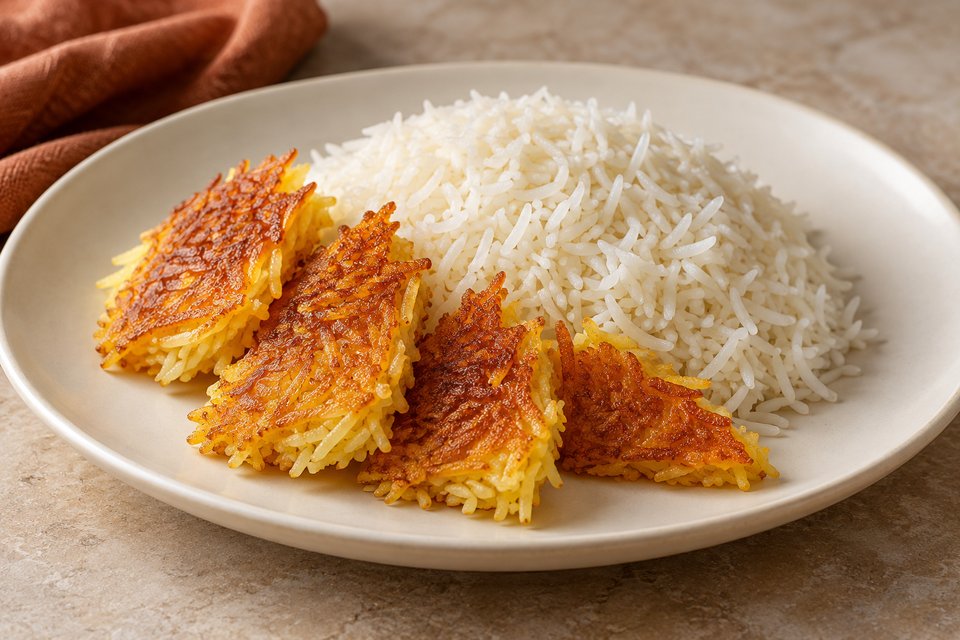
A rice crust, without yogurt or eggs
Tahdig (تهدیگ) is the browned layer at the bottom of the rice pot. This version colors a small portion of parboiled rice with saffron and sets it over oil. Ashmazi's Farsi rice-crust method confirms the same basic layering; its larger rice quantity, saffron measure and soaking schedule are separate from this formulation.
Tahchin uses a rice binder such as yogurt and eggs to make a thicker dish; this recipe has neither. Plain kateh is cooked by absorption. Follow the parboiling steps here instead of substituting already cooked kateh.
Pan width, steam and browning
Shadi's recipe supplies the two-cup rice and oil/butter formulation. It starts with half a cup of saffron-colored rice, so use a modest saucepan and fill any bare patches before adding the rest. A wide skillet is not an equivalent vessel. Follow the pan maker's heat limits and avoid metal tools on its coating.
Culinara specifies measured hot water instead of ice, a smaller pan and a cloth-free lid. These are practical variations from the cited technique; results depend on the rice and pan. The source uses medium heat with a towel-covered lid; this version lowers the heat once steam forms and checks the rice and base separately. A good crust may come out in pieces.
Serve the crust promptly
Butter contains milk; ghee also comes from milk and is not an automatic allergy substitute. This recipe specifies ordinary unsalted butter. It contains no intentional egg or yogurt ingredient.
Steam softens crisp rice during storage, so reheating may not restore its original texture. Use the same prompt chilling and 165°F reheating guidance as for other cooked rice. The illustration is a serving interpretation, not evidence of a cooking test or an achieved crust.
Research sources
- Shadi Hasanzadenemati — Tahdig Recipe, Persian Crispy Rice (checked 2026-10-22)
- Homa — Persian Rice and Tahdig: Several Crust Methods (checked 2026-10-22)
- FDA — Safe Food Handling (checked 2026-10-22)
- Ashmazi — ته دیگ زعفرانی بدون ماست (Farsi saffron rice crust) (checked 2026-10-22)
- Shadi Hasanzadenemati — How to Bloom Saffron (ice method and discussion of hot water) (checked 2026-10-22)
- FoodSafety.gov — Safe Minimum Internal Temperatures (checked 2026-10-22)