recipe
Sabzi Polo: Persian basmati rice with fresh herbs
Dill-forward Persian herbed rice with parsley, cilantro and chives, parboiled then gently steamed with a measured finishing splash—without requiring fish or promising tahdig.
Jump to ingredients and methodPrint using your browser’s Print command.
Ingredients and method
Ingredients
- 2 US cups dry white basmati rice, not instant or brown rice
- Water for a one-hour rice soak, plus 8 US cups for parboiling and a separate 1/4 US cup hot water for steaming
- 2 tablespoons kosher salt for the boiling water, most of which is discarded after draining
- 2/3 US cup coarsely chopped fresh dill, measured after chopping
- 1/2 US cup coarsely chopped fresh flat-leaf parsley
- 1/2 US cup coarsely chopped fresh cilantro
- 1/4 US cup finely chopped fresh chives (ordinary chives may replace garlic chives)
- 1 tablespoon dried fenugreek leaves, optional; do not use fenugreek seeds
- 4 tablespoons vegetable oil or ghee, divided: 2 for pan bottom and 2 for rice top
- 1/4 teaspoon finely ground saffron mixed with 1 tablespoon hot water, optional for a small golden-rice accent
- A little extra hot water only if needed while steaming
Method
- Rinse the basmati several times, cover generously with cool water and soak for one hour. Drain and rinse. Meanwhile wash the herbs under running water, dry well and chop. Measure the chopped herbs loosely. Crumble the optional dried fenugreek leaves.
- Bring eight cups water and the parboiling salt to a boil in a large pot. Add drained soaked rice and stir gently. Begin checking around five minutes: the outside should soften while the center remains firm. Drain carefully in a stable colander and briefly rinse with warm water.
- Reserve about one cup of the parboiled rice in a bowl. Mix this reserved rice with the saffron infusion if using; otherwise leave it plain. Gently fold the fresh herbs and optional fenugreek through the remaining rice.
- Warm two tablespoons of the oil or ghee in a heavy-bottomed nonstick pot over low heat. Spread the reserved rice across the bottom, then loosely add the herb rice without packing it down. Drizzle the last two tablespoons fat over the top and sprinkle with the separate quarter cup hot water.
- Cover with a close-fitting lid and heat over medium until steam builds inside, then lower to medium-low or low as needed to maintain gentle steaming without scorching. Start checking around 35 minutes and continue until the grains are tender. If rice stays firm and the pan has dried out, add a small splash of hot water and cover again. A crisp bottom is optional, not the endpoint.
- Rest off heat for a few minutes, then scoop gently onto a platter. Serve as a rice side with a separately prepared main dish. Refrigerate leftover rice promptly in shallow containers.
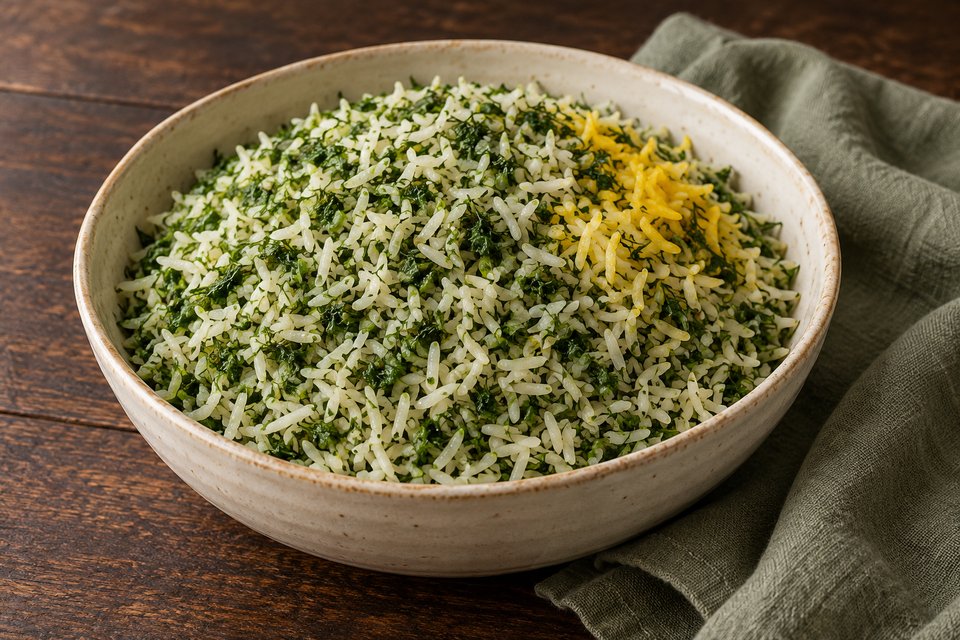
Measure the herbs after chopping
Sabzi polo (سبزی پلو) is Persian rice with fresh herbs, often served with fish for Nowruz. This version uses Omid Roustaei's dill-forward blend, measured after chopping. Shadi Hasanzadenemati uses more dill and chives and a lettuce base; those proportions are kept separate.
Fenugreek leaf is not interchangeable with fenugreek seed. Omid notes that too much of the leaf can make rice bitter; it is optional here. If you want packaged dry sabzi polo herbs, consult the site's Persian herb-mix buying guide rather than substituting an unknown dry mix cup-for-cup.
A rice side with its own method
The rice is soaked, briefly boiled in excess salted water and drained before steaming. It is not an absorption kateh recipe. Reserve the bottom layer before adding herbs so there is plain rice available whether or not you use saffron.
Omid's source includes a separate fish recipe. This page covers only the rice; serve it with a main dish prepared using its own complete instructions.
Steam moisture and storage
The finishing splash is one-quarter cup water, separate from the discarded boiling water. This adaptation uses a plain fitting lid and a scooped serving. It reduces Omid's boiling salt from three tablespoons to two and does not promise the same crust as a cloth-lined lid.
Ghee contains milk; choose the vegetable-oil option if avoiding dairy and check labels. Refrigerate cooked rice at 40°F or below in shallow containers within two hours, or one hour above 90°F. Reheat to 165°F.
Research sources
- Omid Roustaei — Sabzi Polo ba Mahi: Herbed Rice Pilaf with Fish, The Caspian Chef (checked 2026-10-22)
- Shadi Hasanzadenemati — Sabzi Polo Persian Herb Rice, Unicorns in the Kitchen (checked 2026-10-22)
- U.S. FDA — Safe Food Handling (checked 2026-10-22)