recipe
Baghali Polo: Persian dill rice with frozen fava beans
Persian dill rice with peeled green fava beans, a clear parboil-and-steam method, and practical guidance for choosing the right frozen bean product.
Jump to ingredients and methodPrint using your browser’s Print command.
Ingredients and method
Ingredients
- 2 1/2 US cups dry white basmati rice, thoroughly rinsed
- 10 US cups water for parboiling the rice and beans, discarded after cooking
- 1 1/2 tablespoons kosher salt for the rice boiling water, most discarded and rinsed away
- 14–16 ounces peeled frozen green fava beans (broad beans), with both pods and tough inner skins removed; avoid fava beans if you have G6PD deficiency
- 1 US cup chopped fresh dill measured loosely after chopping, or 1/3 US cup dried dill
- 4 tablespoons neutral vegetable oil for the rice pot
- 1 tablespoon unsalted butter for the finish (or olive oil instead for a non-butter variation)
- 1/8 teaspoon ground culinary saffron bloomed in 2 tablespoons warm water, optional
- 1–2 tablespoons extra hot water only if needed during steaming
Method
- Check that the bag contains peeled green fava beans, with neither pods nor leathery inner skins. Read its thawing, cooking and temperature directions. If the label permits, briefly rinse the beans under lukewarm water to separate them and drain. If the package requires a separate boil or another specified cooking method, cook the beans as directed and drain them; add these cooked beans during layering rather than boiling them with the rice. Do not taste uncooked frozen beans.
- Rinse the basmati several times and drain. Wash the fresh dill, dry it well and chop; measure one loosely filled cup after chopping. For the dried-dill version, use the separate 1/3-cup amount. Use a heavy 5- to 6-quart pot with a close-fitting lid for steaming.
- Bring the 10 cups water and salt to a rolling boil. Add the rice, stir gently once and maintain a boil. Begin checking a cooled grain at about 6 minutes; the outside should be soft while the center still has a firm bite. If using the briefly rinsed peeled beans, add them now, let the water return to a boil and drain immediately. Briefly rinse the rice mixture with cool water and drain thoroughly. Beans already cooked according to their package stay out of this step.
- Warm 2 tablespoons oil in the empty pot over medium heat. Add a thin layer of rice, then loosely layer the remaining rice, dill and any separately cooked beans. Keep the layers airy rather than pressing down. Drizzle the remaining 2 tablespoons oil, melted butter and optional saffron water over the rice.
- Cover and keep over medium heat until steam begins to rise, checking within about 5–10 minutes. Reduce to low and cook covered until the grains are tender and the beans are fully heated and soft, starting to check after 35 minutes and allowing longer as needed. Meet any cooking temperature on the bean package; a brief parboil alone is not the final cooking step. If the pot is dry but rice is still firm, sprinkle 1–2 tablespoons hot water over it, cover and steam a few minutes more. Use the lid alone, with no loose cloth near the burner.
- Scoop gently onto a platter without trying to invert a crust. Serve promptly, or divide into shallow containers and refrigerate within 2 hours (1 hour above 90°F). This is the rice side only; choose a separate fully cooked main if desired.
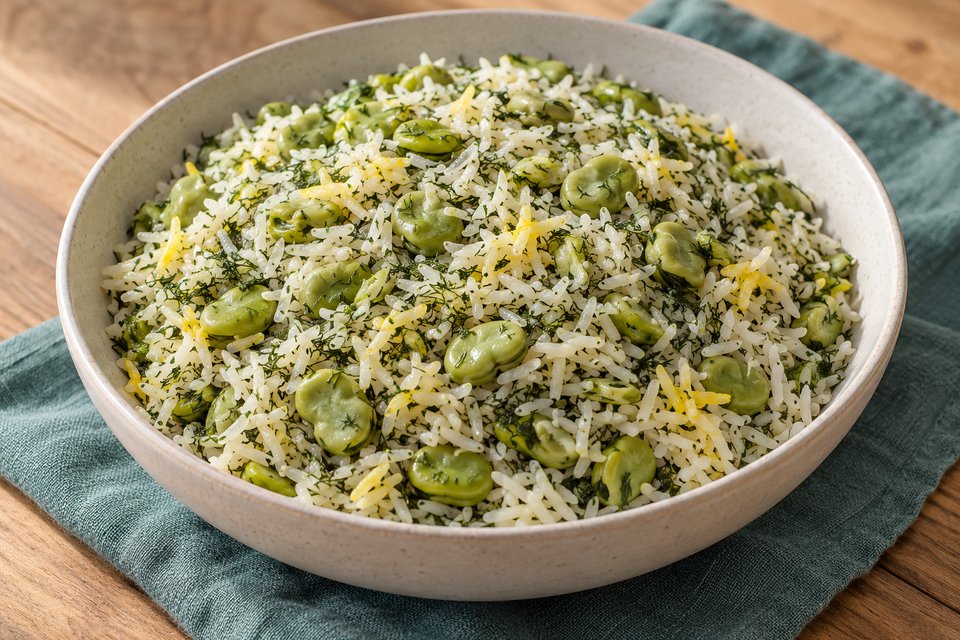
Choose peeled green fava beans
Baghali polo (باقالی پلو; also baghali polow) is dill rice with fava beans. Buy the tender green bean, removed from both its pod and tough inner skin. Al Wadi's manufacturer page, for example, lists a 400-gram frozen product explicitly called Peeled Green Broad Beans. A package simply labeled broad beans may still have the inner skins; read the actual bag.
Homa's rice formula uses 14–16 ounces prepared fava beans with 2 1/2 cups basmati and either 1 cup fresh dill or 1/3 cup dried dill. Mastering Persian Cooking uses much more dill and discusses tender versus tougher beans. Baby lima beans and edamame are different ingredients, not interchangeable names for fava.
Parboil, then build steam
The first boil softens the rice edges; the covered finish cooks the center. Homa adds prepared tender beans just before draining the rice. A bag requiring longer cooking needs its own package-directed preparation before layering. FoodSafety.gov advises following frozen-vegetable cooking and temperature instructions, even when a product looks ready to eat.
This adaptation keeps Homa's measured rice, dill and fat amounts, with reduced boiling salt, a plain rice base instead of bread and no lid towel. The initial medium-heat steam stage follows Mastering Persian Cooking. The small extra-water allowance is an editorial rescue only if the pot dries before the rice is tender. Scoop the rice to serve; no particular crust or one-piece release is promised.
Fava-bean warning, dairy and leftovers
People with G6PD deficiency should avoid fava/broad beans: they can trigger the destruction of red blood cells, called hemolytic anemia. HRSA and MedlinePlus identify this specific trigger. This rice is not an appropriate way to work around that restriction.
The butter contains milk; olive oil is a different finish with no intentional milk ingredient. Refrigerate cooked rice promptly at 40°F or colder and reheat leftovers to 165°F.
Research sources
- Homa — Baghali Polo ba Morgh (fava bean and dill rice portion), Persian Mama (checked 2026-10-22)
- Mastering Persian Cooking — Baghali Polo (Fava Bean and Dill Rice) (checked 2026-10-22)
- FDA — Safe Food Handling (checked 2026-10-22)
- U.S. HRSA Newborn Screening — G6PD Deficiency (fava bean trigger) (checked 2026-10-22)
- Al Wadi Al Akhdar — Peeled Green Broad Beans, 400 g frozen product (checked 2026-10-22)
- Homa — Persian Steamed Rice, including baghali polo method (checked 2026-10-22)
- FoodSafety.gov — New Chef in the House? Use Food Safety to Cook Easy Meals (checked 2026-10-22)
- MedlinePlus — G6PD deficiency, food triggers and prevention (checked 2026-10-22)
- FoodSafety.gov — Safe Minimum Internal Temperatures (checked 2026-10-22)